You Can See Everything

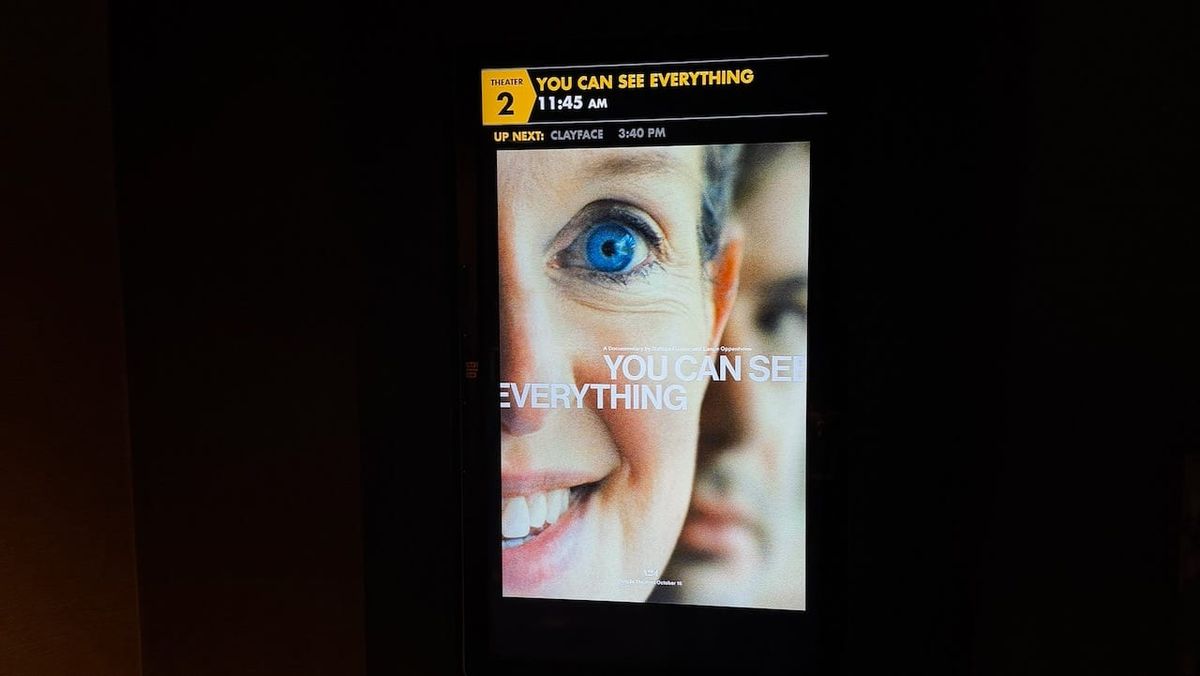
The Theranos story should be familiar to most people by now. I had read John Carreyrou's Bad Blood and listened to the audiobook, and both had left a strong impression. (I hadn't watched The Dropout, though.) By the time I saw the trailer for You Can See Everything, it had been years, and I was not particularly eager to return to Elizabeth Holmes's story. I thought I might watch it eventually, when it came to streaming.
Then I listened to an episode of the New York Times's The Daily about the film. It left me agitated, impatient to see the film before I accidentally learned too much. So I went to the theater this past Sunday, and the film held my attention in a way I had not expected from another telling of this story.
I will keep this short to avoid giving too much away. This was my first encounter with Nathan Fielder's work. The film runs for nearly three hours. For roughly the first half, it felt like a documentary, just as I had expected, with a fairly familiar arrangement: Nathan observes, and Holmes and her partner, Billy Evans, are the subjects. His eyes become ours as he follows their lives during the thirty-four days before Holmes begins her prison sentence. We watch how they speak and behave, and try to decide what to believe. Her conviction is already a fact, but the film lets us consider the way they present themselves: as people responsible for what happened, as victims themselves, or somehow both.
In the second half, however, it suddenly seemed to change genres and become a detective thriller. With Holmes in prison, the film loses access to its central subject, and the arrangement changes. Nathan himself becomes someone we have to watch. And another “her” enters the story, giving us a new pair of eyes through which to look at him. I found that shift thrilling. I had been looking alongside him, and now I was looking at him, wondering whether his closeness to the people he was filming had affected his judgment.
Or was he performing that uncertainty for us? My own inclination was to think that he was actually “playing a role,” and that “her” role might also be part of his “direction.” That possibility was the smartest part of the film for me. Even as I questioned his judgment, I had to question how deliberately he was inviting me to do so. It kept the film exciting until the end, because I could no longer take the person guiding my attention for granted.
Nathan sustains that ambiguity so well that I can imagine people leaving the same screening with very different conclusions. I have my own, but I would rather leave those for a conversation after watching it.
Still, enjoying it did not mean feeling comfortable with it. What stayed with me were the unnervingly intense eyes. Living in the Bay Area, I see so many eyes like those that the look felt uncomfortably familiar. At least, I would like to tell younger people finding their way here that they do not have to “act” that look just because they are in Silicon Valley.