Crimson Desert

This past week, Crimson Desert has been everywhere, sitting right at the center of the conversation before launch. There were interviews, technical demos, and carefully edited gameplay clips coming out of Pearl Abyss, each one trying to show a bit more of what the game could be. And almost immediately, the tone of the reaction settled into something familiar: "It is too good to be true." The kind of good that makes you pause and wonder what is not being shown. Across forums and comment sections, the same sentiment kept repeating itself. People were interested, even impressed, but cautious. You could feel that hesitation in a simple line that showed up again and again: "I will not buy it until the official reviews are out." It was not outright skepticism. It was something quieter, more measured. A kind of learned patience, especially since Starfield.
And the game was out last Thursday (3/19), and its Metacritic score landed at 78. The graphics were as impressive as expected. But many players criticized the weak story and confusing UI. Some even said they refunded the game. The developer’s stock dropped roughly 30% in a single day.
At that point, I thought this might be another case of an overpromised Korean game that did not fully deliver. Something that looked bold and ambitious, but not quite finished. But then my wife nudged me to give it a try
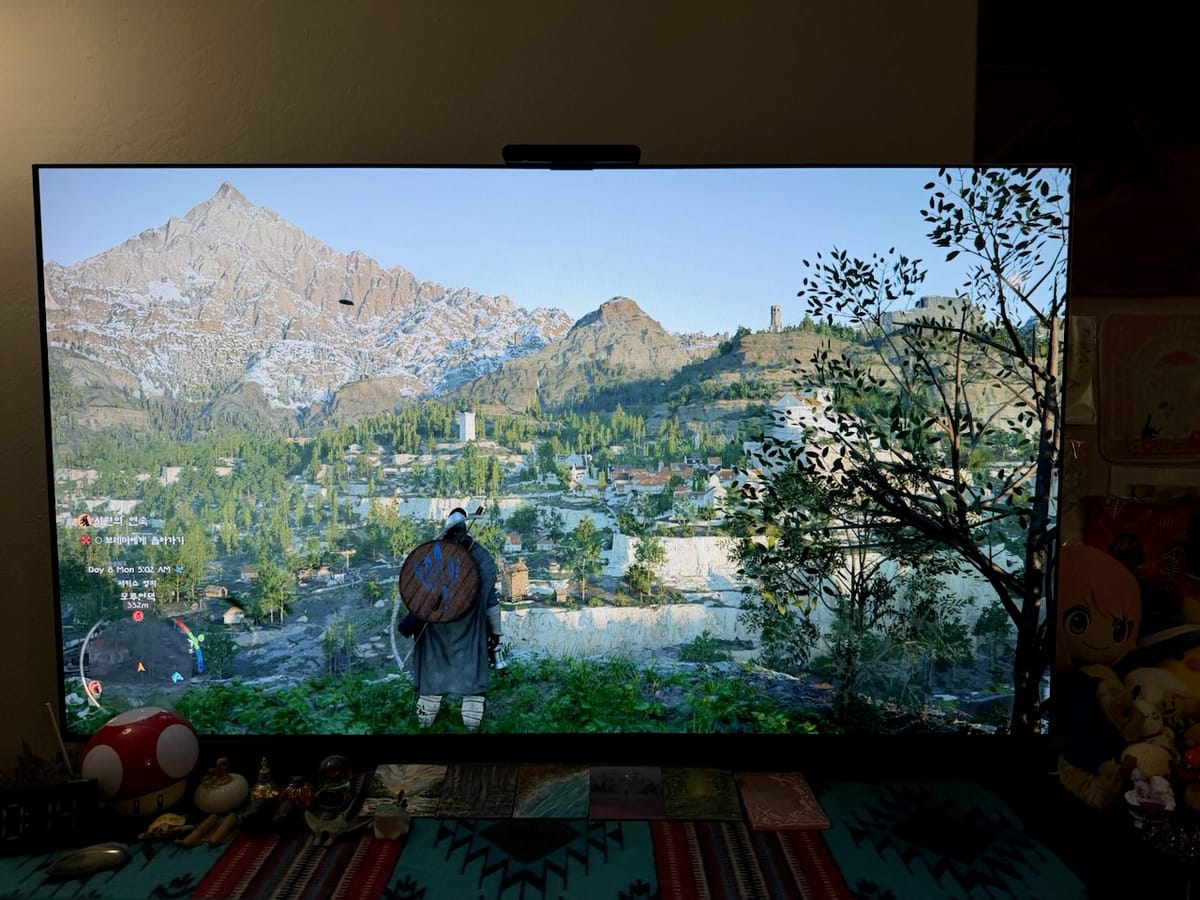
Watching someone play games has somehow become a popular family activity in our house (my wife is playing Dragon Quest 7 Remake). So I picked it up last weekend, partly out of curiosity, and partly to give my Xbox Series X a reason to wake up again since Clair Obscur: Expedition 33. And then, somewhere along the way, I realized something.
"This is my game."
Let me explain why, especially for me.
I had been, yes had been, in the game industry for more than 20 years. That was back in Korea, when the country was a real powerhouse of MMORPGs and online games. It was the center of everything I was working on, building systems for worlds where thousands of players would gather, compete, and live together.
But here is the strange part. I am an INFJ type of person, and I was never fully comfortable in those worlds. I wanted the fantasy, the immersion, the feeling of living in another place. But I did not want the constant presence of other players. The noise, the expectations, the subtle pressure to interact. I built MMORPGs, but I never truly enjoyed playing them. I wanted the world, not the crowd.
That is probably why games like The Legend of Zelda: Breath of the Wild stayed with me. It gave me space. It let me exist inside a world on my own terms. But even that felt, in some way, contained. Beautiful, but still designed with clear boundaries.
And then came Crimson Desert.
This felt different.
It felt more like a fantasy simulator, something overflowing, not just overflowing but massively overflowing, with content in a way that is almost hard to describe. Not just things to do, but a world that seems to exist whether I am paying attention to it or not. For the first time in a while, it felt like I could just be there. I finally found a place to enjoy without worrying about other players, not to mention the risk of service closure.
It might be a bit late to say this, as many people are now saying similar things. On Steam, the reviews have already shifted to “Very Positive.” The stock price has also bounced back, rising 20 to 30 percent again over the past few days.
Still, I feel like I have to say this. Thank you to the developers of Crimson Desert. Thank you for creating a place where I can simply exist and enjoy. For me, this should be this year’s Game of the Year.
When we assess a game, we usually fall back on something like a radar chart. Story is a 5, combat is a 3, UI is a 2, and we draw a nice balanced shape that tells us how “good” the game is. With that method, Crimson Desert would not score well. That kind of five-point system assumes everything should live within a reasonable range. It assumes balance is the goal. It rewards consistency, not extremes. And most of the time, that works. It helps us compare games, rank them, and feel like we are being fair. But what if a game simply refuses to fit into that shape?
What if the story is a 1, the controls are a 2, but the combat feels like a 70, and the open world feels like a 100? At that point, the chart breaks. Not mathematically, but conceptually. The scale no longer makes sense, because it was never designed to measure something extraordinary. And this game shows me what extraordinary can feel like.