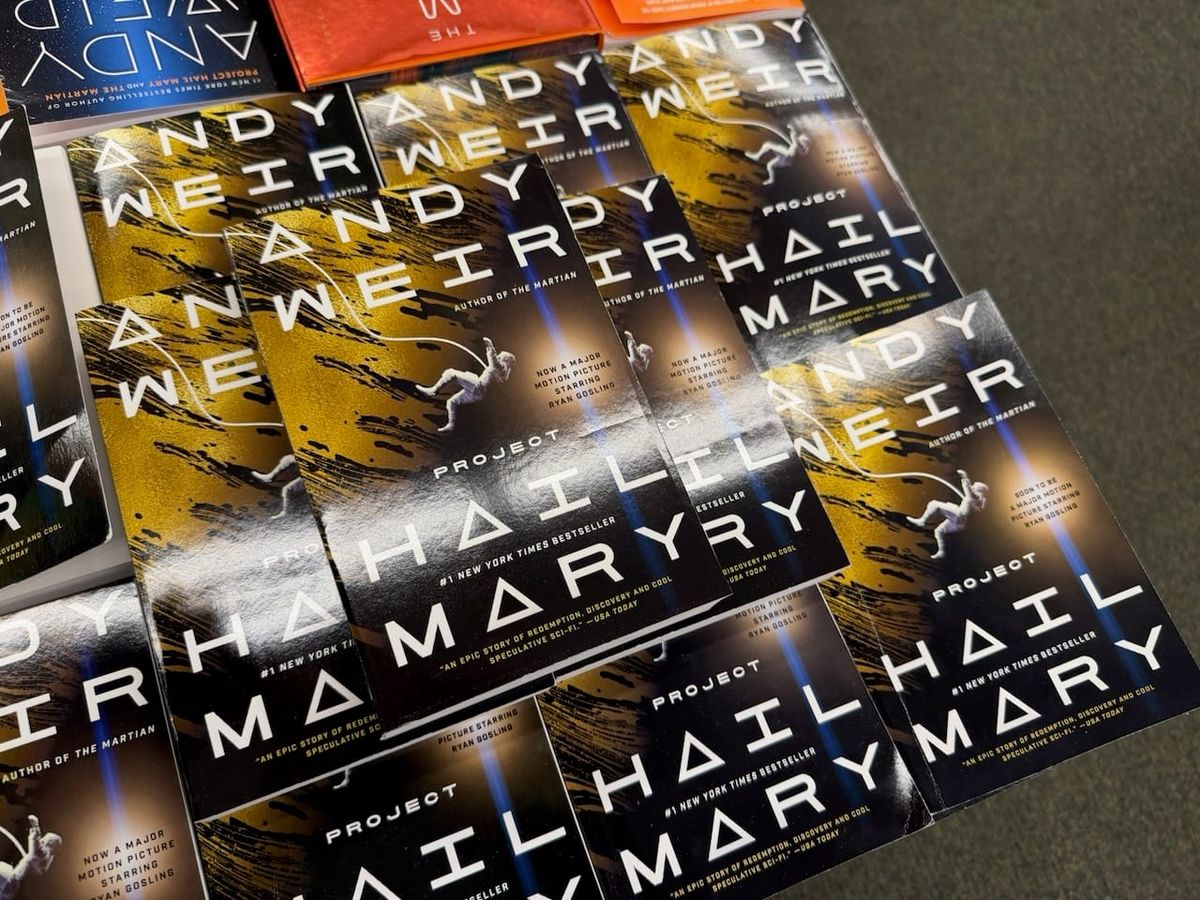
Project Hail Mary

Spoiler alert: this post has a weak spoiler of Project Hail Mary by Andy Weir.
For Ms. Salle's book club this time, we chose Project Hail Mary by Andy Weir. It was my first time reading one of his books. I had really enjoyed The Martian, another story in which Matt Damon needs to get home, but I had only seen the movie. This time, I wanted to begin with the novel.
There was a more immediate reason for that choice. In April, I visited Korea with my family, and my wife and daughter went to see the Project Hail Mary movie. I could not join them. Since I had missed it, I thought I might as well read the book before watching the adaptation. That made it an easy choice for the book club.
What impressed me the most was the detail Weir put into the science-fiction setting and its scientific explanations. He gives the reader enough detail to follow how a problem is understood and how a possible solution emerges. Even when the premise is invented, the reasoning gives it a sense of reality. I could see why something worked, what its limits were, and why the next problem followed from it. That attention to consequences made the world convincing to me. This is what is called "verisimilitude," which I know many readers consider important in fiction these days. (Though frankly, I think Weir takes it too far in this book.)
My favorite example was the Eridians' lack of knowledge about relativity. Here was a civilization capable of interstellar travel that had missed something fundamental to our understanding of the universe. I would normally assume that anyone who could build such a spacecraft must know what we know about the physics involved. The Eridians made me reconsider that assumption.
It made me think about how an environment can shape the history of science and technology. Different conditions can make different observations possible and different questions urgent. Even if the physical laws are the same, the order in which we discover them does not have to be. Something familiar to us could remain an important gap in another civilization's knowledge, while they have solved problems that still puzzle us.
It reminded me of Harry Turtledove's short story “The Road Not Taken,” which also plays with the idea that technological development can follow a very different sequence from our own. A breakthrough in one field does not tell us how far a civilization has progressed in every other field. I like that possibility in science fiction.
After finishing the book, I watched the movie. I missed the discussion of relativity (I couldn't find it!), especially because it had been my favorite part of the novel. Still, I thought the film made a very good choice about how much explanation to carry onto the screen. A book has room to follow a line of reasoning at length, and I enjoyed spending that time with it. The film had to find its own way to make the story appealing. It captured what was attractive about the story without going as deeply into the science as the novel did. I could appreciate that choice while still wishing my favorite detail had found a place in it. At least I really enjoyed seeing the Hail Mary and the Blip-A on screen. I had never imagined the Blip-A in that shape, a tangle of interconnected lines like spaghetti.
Rocky's echolocation also reminded me of An Immense World by Ed Yong, another book we read for the book club. In my post about it, I wrote about my surprise at learning that even humans could echolocate. The book made me realize that the world I experience is only one version, shaped by my senses. Rocky made me think about that again: how different the same surroundings might be to someone who perceives them through sound.
The ending left me wondering what I would do if I had to make Grace's choice. I think I might try to find a way back to Earth eventually. The novel gives him a life on Erid while leaving room to wonder whether he might ever return. That possibility led me to another question: what kind of world would be waiting for him?
By the end, the Sun has recovered. But I kept wondering what would happen to humanity afterward. The same Astrophage that threatened the world also offers an extraordinary way to store and use energy. With the immediate danger overcome and that capability available, people could build a very different future. Would it bring peace, or an age in which “Live Long And Prosper” became an ordinary expectation? I would like to imagine that this is the Earth Grace might return to. Unfortunately, I cannot tell.