Tales from Earthsea

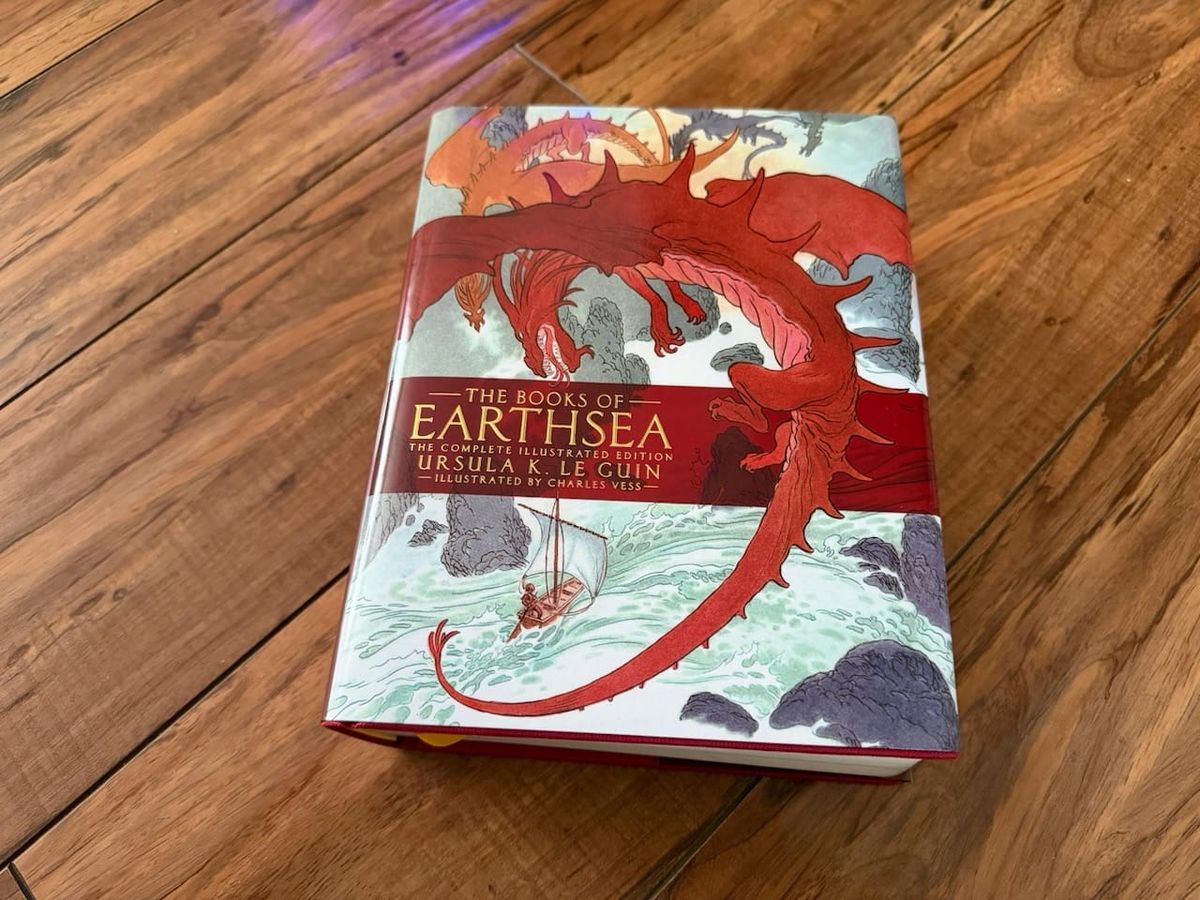
The next book club selection with Ms. Salle was the Earthsea Cycle by Ursula K. Le Guin.
The first book I read in the club was The Dispossessed, and I became almost obsessed with the beauty of her prose. I even tried to imitate her writing style for a while. At one point, ChatGPT pointed out one of her recurring stylistic habits: layered or paired descriptors, simple descriptive words placed together with a strange emotional rhythm. I still remember lines from The Dispossessed like “uncut rocks roughly mortared” or “Like all walls it was ambiguous, two-faced.” The words themselves are not difficult or flashy, but together they create a quiet philosophical weight that stayed with me long after I finished the book.
So it was exciting to step into another world she created. For the club, we read the first three Earthsea books: A Wizard of Earthsea, The Tombs of Atuan, and The Farthest Shore.
Frankly, the books were not “exciting” in the way modern fantasy (e.g., Harry Potter) often is. There are no giant battles every hundred pages, no endless plot twists, and no elaborate systems designed like RPG skill trees. But the world itself is beautiful in a very quiet way, and the idea that stunned me most was the weight of the “true name.”
In Earthsea, knowing the true name of something gives you power over it. Not symbolic power, but real power. Names are tied directly to the nature of the world itself. I have encountered countless stories influenced by this idea since then, in novels, games, anime, and films, and after reading Earthsea I began to suspect this might have been one of the great origins of that entire tradition.
While reading, another work kept surfacing in my mind, a very famous one, though at the time I still had not fully connected the dots.
Originally, I thought this post would mainly be about that theme: names, identity, and the strange emotional weight hidden inside them. But then something unexpected happened. While scrolling through Instagram, I happened to see an ad for this year’s Studio Ghibli Fest lineup, and among the titles I noticed something that genuinely surprised me: “Tales from Earthsea.”
I was honestly shocked. Somehow, I had never realized that Studio Ghibli had adapted Earthsea at all. It turned out this was the only major Ghibli film I had never watched. Part of the reason was probably the original title. In Japanese and Korean, the movie was released under a title closer to “ゲド戦記—Ged’s War Chronicles,” which completely disconnected it from “Earthsea” in my mind (Ah, Ged’ is the Ged, now I got it). I remember it had so awful reputation at the time, so I skipped it without much thought and eventually forgot it existed entirely.
It looked like a Ghibli movie, but strangely, it did not feel like one. The visual style was unmistakably Studio Ghibli, yet the film itself felt oddly flat and distant. The cuts were surprisingly static and uninteresting. Many scenes were composed almost entirely of giant close-ups of characters talking, usually with only two or three people on screen. There was very little sense of movement or rhythm. The only sequence that genuinely impressed me was the shot where Ged rides his horse toward the castle while Therru remains in the frame, becoming smaller and farther away as the camera slowly pulls back. But most of the time, it felt less like a grand anime film (as other Ghibli’s) but more like a low-budget adaptation trying to imitate the surface of Ghibli without fully understanding its cinematic language.
What surprised me even more was how loosely the movie treated Earthsea itself. The film mostly borrowed characters and fragments from across the series while using The Farthest Shore as the rough backbone of the plot. Arren and Ged are the central figures, but Tenar and Therru also appear, even though they belong primarily to later books, especially Tehanu. Since I had not read Tehanu yet, Therru’s role initially confused me. The result is a story that feels less like an adaptation and more like several Earthsea books cut apart and reassembled into a different shape.
Studio Ghibli adaptations are often radically different from their source material. Kiki’s Delivery Service, for example, changed many things from the original novel while still creating a coherent emotional world of its own. Thematically, the film still seems interested in the same core idea as The Farthest Shore: mortality, the fear of death, and the acceptance of impermanence. However, I think Tales from Earthsea never quite finds that coherence.
Arren especially felt different from the version in the novel. Arren was initially uncertain and immature in the novel, but his gradual growth into a future king felt convincing and emotionally grounded. Throughout The Farthest Shore, he learns through fear, failure, responsibility, and his journey alongside Ged. In the film, however, he often feels simply miserable and emotionally vacant, and then, rather suddenly, recovers through Therru’s presence and encouragement. The transition felt abrupt to me, almost emotionally unearned. Watching it, I could not stop thinking about Goro Miyazaki himself. It is hard not to read some of the movie as the anxiety of a son trying to prove himself under the shadow of an impossible father. Arren sometimes feels less like a fully formed character and more like someone desperately waiting to be saved or recognized by an external force he cannot understand.
Yet despite all of this, the movie unexpectedly helped me connect the “dots” I had been thinking about while reading Earthsea.
Because behind it stands Hayao Miyazaki, a creator who may actually have understood Earthsea’s themes more deeply than the film itself. The power of names, the loss of identity, the strange boundary between greed and desire, the fear of forgetting oneself—those ideas could be expressed throughout Spirited Away. While reading the books, I kept feeling that another famous story was echoing somewhere in the back of my mind, and only after watching Tales from Earthsea did I finally realize what it was. In a strange way, Spirited Away almost feels spiritually closer to Earthsea than Tales from Earthsea does.
That is why Tales from Earthsea leaves me with an odd feeling. Not hatred. More like regret. The themes were there. The world was there. The studio was there. Somehow, the movie still could not quite reach them.